
What Is a Custom App, and When Does Your Business Need One?
All Industries2 May 2026

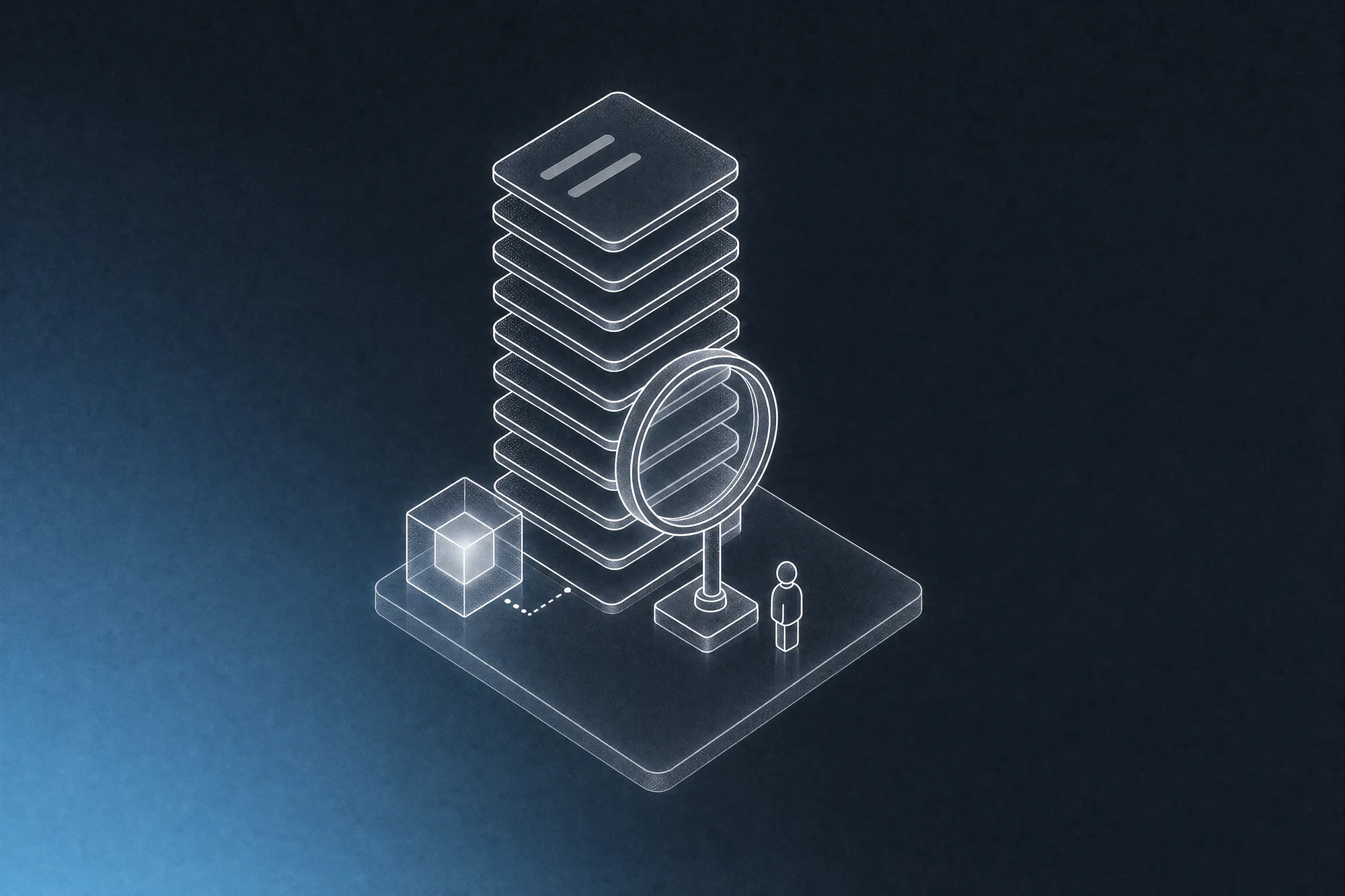
Two numbers from this year belong side by side. Both describe the same thing: building software by dictating your intent to an AI, now widely called vibe coding. At one mid-sized technology company under a mandate to double output, merged code changes per person hit 2.09 times baseline by April 2026, across 802 developers and 196,212 pull requests (Source: arXiv:2607.01904, 2026). Across 623 million code changes since 2023, duplication rose 81% while how often developers touch and reuse existing code fell 70% (Source: GitClear via LeadDev, 2026). Both are true at once.
The short answer for a business owner: yes, the first working version of a custom app can now land in days to weeks, not the months it used to take. What has not shrunk is everything after that — review, integration with your existing systems, protecting customer data, years of maintenance. Building software did not get cheaper in the AI era; the cost moved, from writing code to proving the code is fit for your business.
The term came from a casual Andrej Karpathy post on X in February 2025: give in to the vibes, let the AI write the code, stop caring the code exists. The context was a throwaway weekend project, not a system a company runs on. Merriam-Webster listed it as trending slang in March 2025; Collins English Dictionary made it Word of the Year 2025 (Source: Wikipedia, 2026).
Karpathy has moved past the term himself, which the popular explainers rarely mention. In an April 2026 piece he splits it in two. Vibe coding raises the floor, letting almost anyone produce working software by describing what they want. Agentic engineering raises the ceiling, and it is a professional discipline: detailed specs, supervised agent plans, every change checked, standards held. One line is worth quoting to any vendor you interview: shipping a security hole is not an acceptable side effect (Source: Andrej Karpathy, 2026).
GitHub draws the same line in its own explainer. It suits a few cases:
And it fits badly in production code that skips rigorous review, real-time or hardware systems, and workflows demanding precision. GitHub's named risks are specific: debugging in the dark because nobody understands the structure, technical debt, maintenance trouble, and security holes such as hardcoded credentials or unvalidated endpoints (Source: GitHub, 2026).
This part is rarely told honestly. A randomised trial at Google with 96 full-time engineers found time on one enterprise-grade task fell about 21% with three AI features on, though the confidence interval was wide (Source: Paradis et al., arXiv, 2024). METR's trial found the reverse: 16 experienced developers on 246 real issues in their own repositories were 19% slower with AI, having forecast 24% faster and still feeling 20% faster afterwards (Source: METR, 2025). In February 2026 METR corrected itself: newer data suggests developers probably are faster now, but it called its own design unreliable and is rebuilding it (Source: METR, 2026).
So there is no clean number. There is a pattern. The company running at 2.09 times throughput also logged roughly double the workload per reviewer, and automated review overtook human review by volume (Source: arXiv:2607.01904, 2026). A Y Combinator managing partner said 25% of the Winter 2025 batch had codebases 95% AI-generated, while stressing these were deeply technical founders who could have written it themselves (Source: TechCrunch, 2025).
The maintenance data is uncomfortable. Alongside that 81% rise in duplication, cleanup of legacy code fell 74% and the habit of swallowing error signals rose 47% since 2023 (Source: GitClear via LeadDev, 2026). Veracode ran 80 coding tasks in four languages: only 55% of AI-written code passed security testing, the rest carrying familiar vulnerability classes such as SQL injection and weak cryptography, with Java at 29%. Syntax correctness now runs above 95%, while the security figure has sat near 55% for two years. The models got fluent, not safe (Source: Veracode, 2026).
The people using these tools daily know it. Stack Overflow's 2025 survey found 84% of developers use or plan to use AI tools, yet only 3.1% highly trust its accuracy, and 66% named their biggest frustration as answers that are almost right but not quite (Source: Stack Overflow, 2025). Google Cloud's DORA report found the same shape: AI adoption correlates positively with delivery speed and negatively with system stability (Source: Google Cloud, 2025).
Start with money and time. One Indonesian software house lists a prototype at Rp 3 juta to Rp 50 juta in 2 to 6 weeks, and a mid-level business app at Rp 150 juta to Rp 400 juta in 3 to 6 months (Source: Crocodic, 2026). Two to six weeks is today's realistic fast case; a mid-level app is still counted in months. Hiring your own is no shortcut: Software Developer ads in South Jakarta and South Tangerang list Rp 13 juta to Rp 14 juta a month (Source: Jobstreet Indonesia, 2026), and Indonesia needs some 12 million digital talents by 2030 against about 3 million available (Source: ANTARA News, 2025). The vendor's cost base has genuinely shifted: 9 in 10 Indonesian developers report productivity gains of 20% to 50% from generative AI, across 3,163 respondents (Source: Dicoding via detikINET, 2026). Price and timeline should reflect that, not 2023's.
In our experience at Agentiq, though, the prototype is not the expensive part. The expensive part is operational reality, which no AI can guess from a prompt: orders arriving as WhatsApp voice notes, transfer-receipt photos matched against the bank statement each morning, Shopee and Tokopedia order sync, invoice formats that must survive a tax audit. The largest blocks of time in our projects go to mapping the workflow as it actually runs, before any code is written, and to reviewing AI output before it touches real data. Because the building part is far more efficient now, the starting price of a custom app genuinely can fall. The review, the hardening and the maintenance do not fall, and they are not what we cut.
One more reason is specific to Indonesia. Any app holding customer names, phone numbers, addresses and transaction histories falls under the Personal Data Protection Law, UU PDP. Administrative sanctions reach 2% of annual revenue, and the criminal provisions extend to five years and/or Rp 5 miliar for unlawfully collecting personal data (Source: K&K Advocates, 2024). For a business turning over Rp 500 juta a month, 2% of annual revenue is a figure you feel. An endpoint with no authorisation check stops being a technical matter and becomes a board-level one.
If you are weighing up a custom app and want to know how fast a first version realistically lands, and what still takes time, tell us how your business runs through our contact page. The Agentiq team will answer with scope, sequence and concrete numbers, not a template.
Tell us what you need, and we will help turn it into a real application.
