
Human in the Loop: How to Stay in Control of Your AI Agents
All Industries21 September 2026
Eleven percent. That is the average rise in patient attendance when healthcare providers send appointment reminders, according to a March 2026 meta-analysis pooling 10 randomised controlled trials with 8,236 participants across 9 countries, Malaysia among them (Source: Al-Turbag, Mooney & Corry, Journal of Hospital Management and Health Policy, 2026). The figure is real. It is also far smaller than the "no more no-shows" promise in chatbot vendors' brochures, which rarely cite any study at all.
AI for clinics earns its keep in admin work: taking bookings over WhatsApp, sending reminders with confirm or reschedule buttons, filling released slots from a waiting list and reminding patients of follow-up visits. It does not diagnose, suggest medication or read medical records to make decisions; any message about complaints or symptoms goes to staff. The biggest gains come from a two-way booking loop recorded directly in the clinic's own system, not from reminders alone.
That 11% comes with an important caveat. Variation between studies was high (I² = 83%), meaning results depend heavily on where and how reminders are run. In the same review, phone-call reminders had a statistically significant effect, while SMS alone did not yet reach significance (risk ratio 1.14, confidence interval 0.99 to 1.31). Only 3 studies reported costs, and the authors flagged privacy risks when reminders land on a shared phone (Source: Al-Turbag et al., JHMHP, 2026).
A German study shows how much context matters. At a private eye practice, appointments patients booked themselves online had a median no-show rate of 1.8%, against 5.9% for phone or walk-in bookings, across 16,894 appointments. At a university hospital with 81,173 appointments, the result flipped: online bookings were missed more often, averaging 14.3% versus 11.2% (Source: Frontiers in Digital Health, 2025). A patient choosing their own slot at a private clinic behaves differently from a referred hospital patient.
US data points the same way. In an August 2025 MGMA poll of 265 US medical group practices, 27% saw no-shows rise year on year, 60% held steady and just 13% saw a decline. Practices that kept the number down credited consistent communication, clear policies and two-way messaging that makes it easy for patients to confirm or move an appointment (Source: MGMA Stat, 2025).
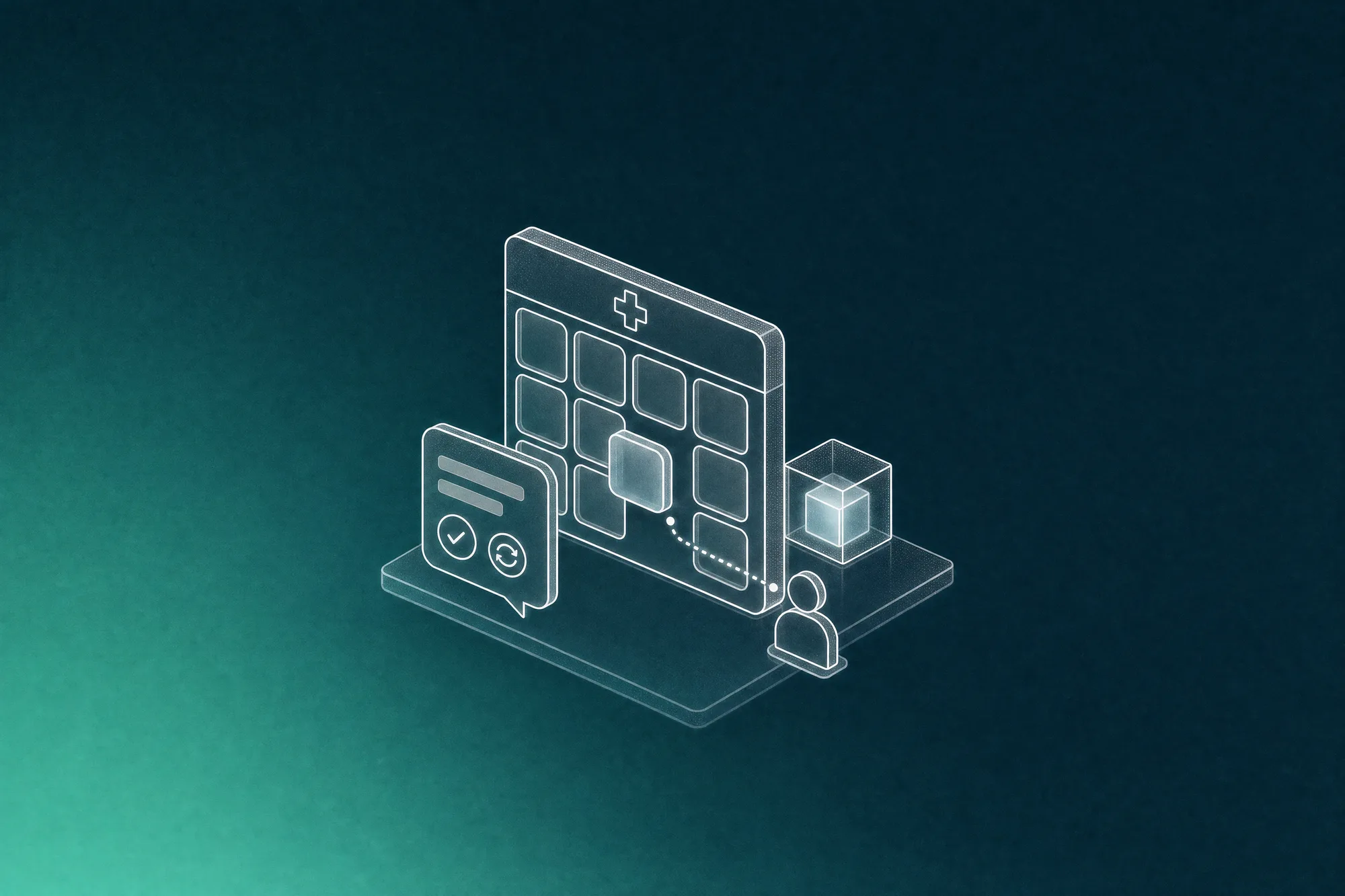
A one-way reminder only informs. A two-way loop solves the problem: the patient taps Confirm or Reschedule, the released slot is offered straight to the next person on the waiting list, and the dentist's chair doesn't sit empty.
Picture a private dental clinic in Bekasi. Patients plan their week on Sunday evening, long after the receptionist went home at 5 pm. Monday morning opens with a pile of unanswered chats while the phone rings and walk-in patients wait at the cashier. With an AI agent, Sunday night's chats get answered with slots that are genuinely free in the dentist's schedule. Ahead of the visit, the patient receives a single message with the time, the location and two buttons. Anyone who picks Reschedule is offered alternative slots, and the time they release goes to the waiting list. Six months later, the routine scaling reminder goes out without anyone having to remember it.
The receptionist's role shifts rather than disappears. They still handle walk-in patients, payments and every chat the agent flags for a human.
In our experience building agents that reply to customer messages, the hard part isn't getting the AI to answer politely. It is deciding, firmly, which messages it must never answer. For a clinic the list is clear. Anything mentioning symptoms, pain, complications or an emergency goes straight to the staff queue, and emergencies are directed to the ER or Indonesia's 119 emergency line.
One more boundary applies. Patients on BPJS, Indonesia's national health insurance, take their primary-care queue numbers through the Mobile JKN app, so a WhatsApp agent is most relevant for self-pay services: dental, aesthetics, physiotherapy, specialists and employee medical check-ups. It does not replace Mobile JKN.
From 1 October 2026, business replies inside the 24-hour customer service window on the WhatsApp Business Platform (API) are charged per message at the same rate as utility templates, with no volume discount. Messages from patients to the clinic remain free, while AI replies through Meta's Business Agent have been billed per token since 1 August 2026 (Source: Meta for Developers, 2026).
What changes for clinics is the conversation after the reminder. Proactive reminders were already billable, but now every reply to "can I move it to Thursday?" counts too. A chatty flow, five back-and-forths for one schedule change, becomes expensive; a single template with Confirm and Reschedule buttons is far cheaper. Clinics still on the free WhatsApp Business app aren't charged per message, but that app was never designed to run an automated agent. We walked through the monthly cost maths in our September AI News edition.
Health Ministry Regulation (Permenkes) 24/2022 requires every healthcare facility, including clinics and independent doctor and dentist practices, to run electronic medical records (EMR) interoperable with SATUSEHAT, the national health data platform (Source: Permenkes 24/2022, JDIH BPK). A booking agent that keeps its own appointment list in a separate spreadsheet just creates a second record that drifts out of sync. The right design reads open slots from, and writes bookings to, the existing EMR or clinic management system, without ever pulling diagnoses, doctors' notes or prescriptions into the chat layer.
Health data counts as specific personal data under Indonesia's Personal Data Protection (PDP) Law, which we cover in a separate article. A less-cited rule is Article 301 of Law 17/2023 on Health, which obliges every medical and health worker to keep patients' health information confidential (Source: Law 17/2023, Article 301). In practice, a reminder only needs to say when and where, not what for. The procedure or condition has no place in the message, because in many Indonesian households one phone is shared by several people. Consent to WhatsApp reminders is recorded at registration.
This line matches the Health Ministry's principle that AI output in healthcare must be validated by a doctor, with the final decision resting with the doctor (Source: Katadata, 2025). A clinic admin agent doesn't enter that territory at all, and it shouldn't.
For a busy private clinic, a doctor's chair left empty by a no-show is lost revenue you can't bill again. Don't judge a system by the no-show reduction quoted in a brochure. Judge it by your own numbers: how many slots get refilled, how many after-hours chats get answered, and how many paid messages go out per appointment.
If you'd like to see what AI-powered booking and reminders could look like for your clinic, walk us through your process on our contact page. The Agentiq team will reply with concrete recommendations, not a template.

Tell us what you need, and we will help turn it into a real application.
