
The AI Agent Roles With the Fastest Payback: Admin, CS, and Sales Follow-Up
All Industries8 September 2026

You ask for a quote on an AI assistant for your shop's WhatsApp. The first vendor replies, "it depends on your needs, contact us." The second sends a table that stretches from tens of millions to hundreds of millions of rupiah. The third offers a monthly subscription and never explains what happens if your message volume triples. You walk away with three documents and not one number you can compare.
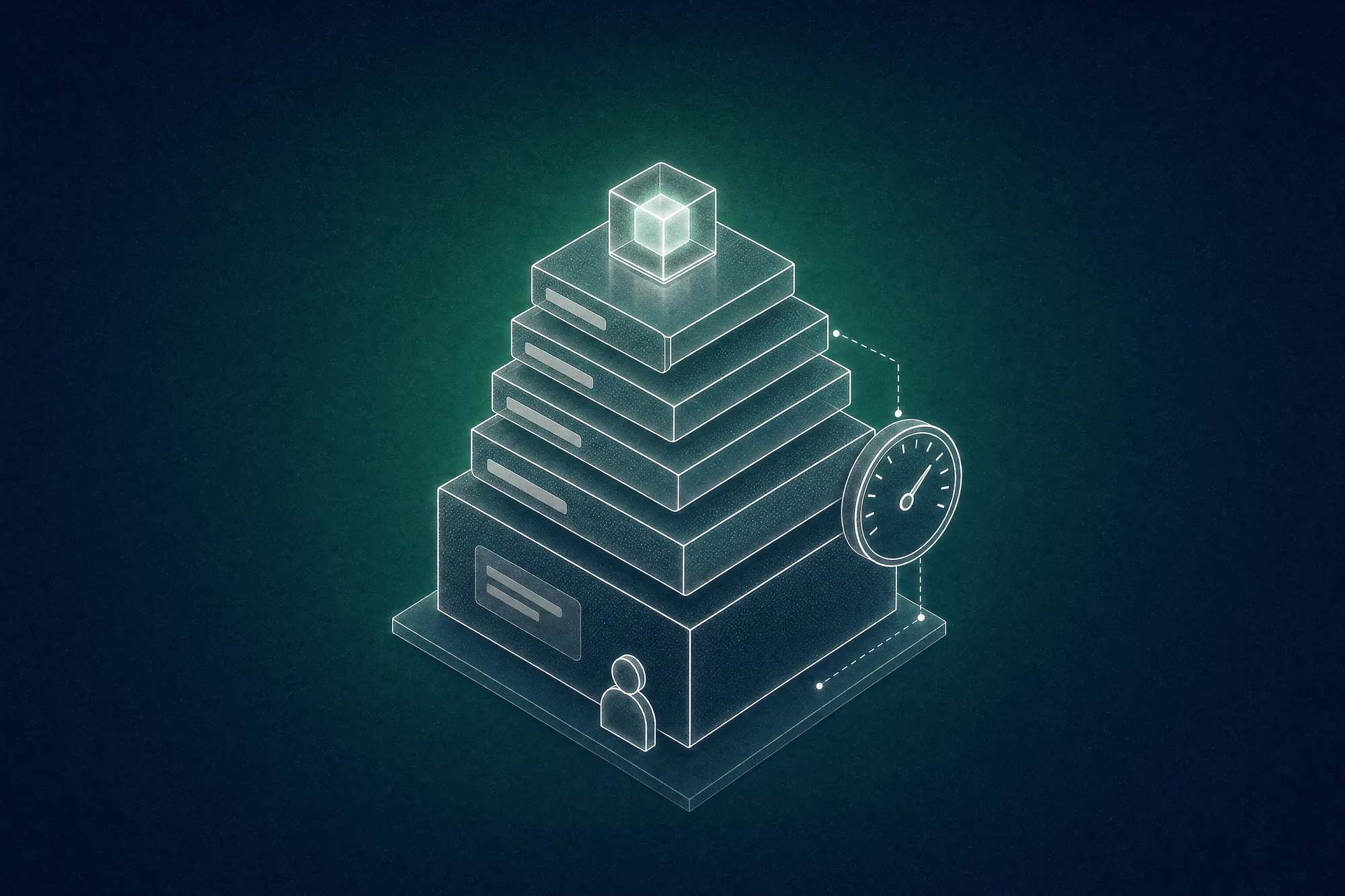
The cost of AI for a business has five components: the initial build, monthly hosting and maintenance, AI model usage, channel fees such as WhatsApp, and your own team's time. As a starting point, Agentiq publishes prices from Rp 2 million for an AI agent and from Rp 15 million for an app or a website. That is a floor, not a quote. The final total depends on which components grow as usage rises.
Most owners ask about the first component only, because it is the one that appears on the quote. The bill you actually pay over a year splits like this.
The fifth component rarely makes it into the budget, yet it is what most often makes projects slip. Good AI still needs someone on your side to say "this answer is right, that one is wrong." We design for humans to stay in control, so that time is not waste. It simply has to be scheduled, not assumed to be free.
The initial build is fixed. Maintenance also tends to be fixed, but vendors bill it in different ways. One local vendor, Next IT, publishes ranges for websites: annual maintenance of 10 to 15 percent of the build cost, hosting at Rp 1 to 5 million a year, and a domain at Rp 200,000 to 500,000 a year (Source: Next IT, 2026). For chatbots, the same vendor lists a rule-based tier at Rp 10 to 30 million plus Rp 2 to 5 million a month, and a CRM-connected tier at Rp 50 to 150 million plus Rp 10 to 20 million a month (Source: Next IT, 2026). These are vendor-published figures, not an independent survey, but they show the pattern: maintenance is almost always priced separately.
Model usage is the component that genuinely scales. To give a sense of size, Anthropic's official price for Claude Haiku 4.5 is 1 dollar per million input tokens and 5 dollars per million output tokens (Source: Anthropic, Claude API pricing documentation, 2 October 2026). In Anthropic's own example, processing 10,000 customer support tickets of about 3,700 tokens each costs roughly 37 dollars. By our calculation from that example, each ticket costs about 0.0037 dollars. At a rough rate of Rp 17,700 per dollar, that is around Rp 65 per ticket, or about Rp 650,000 for 10,000 tickets. This is arithmetic on a model vendor's example, not an Agentiq measurement, and the exchange rate is indicative only.
Do not relax too quickly. Gartner expects inference cost per agentic workflow to rise more than fivefold through 2028 even as per-token prices fall, because multi-step agents consume far more tokens (Source: Gartner, August 2026). An agent that reasons and acts across many steps cannot be priced with a simple chatbot formula. Model tiering, matching the model to the task, and usage caps need to be part of the design from day one.
Channel costs get forgotten because they never show up on a vendor quote. The WhatsApp Business Platform charges per template message sent, across categories such as marketing, utility, and authentication. Rates differ by country and can be billed in rupiah (Source: Meta, WhatsApp Business Platform pricing, 2026). The rules on which messages are free and which are paid can change by quarter, so do not rely on a friend's memory or an old article. Ask for the current rupiah rate card, then ask the vendor to estimate your monthly outbound message volume.
The exchange rate is a separate matter. Model usage is billed in dollars while your revenue is in rupiah. Ask at the outset who absorbs currency swings: you, or the vendor through a fixed price. On tax, for non-luxury goods and services an effective VAT of 11 percent generally applies (a 12 percent rate on a tax base of 11/12 of the price) under Finance Ministry Regulation PMK 131/2024 (Source: DDTCNews, 2026). We have not verified whether that treatment applies exactly to software services, so the practical question stays simple: does the quoted price include VAT or not?
In our experience, pricing conversations get much clearer once the question changes from "how much" to "what is included." That is why we show starting prices on three service pages: AI agents from Rp 2 million, custom apps from Rp 15 million, and websites from Rp 15 million. For apps and websites, our managed service covers hosting, backups, security, and maintenance, so the second component does not arrive as a surprise bill.
We should also be straight about the limits. "From" is a floor, not a final price, and our service pages do not spell out whether the figure is one-off or recurring. Ask the same question of any vendor, us included. For payback periods and contracts, we cover those in a separate article; the point here is just one: never compare quotes whose scope differs.
If you want to see what an AI cost breakdown looks like for your own business, tell us about your process through our contact page. The Agentiq team will reply with a concrete recommendation, not a template, including numbers you can hold up against other quotes.
Tell us what you need, and we will help turn it into a real application.
